The weather in Brunswick is outrageously gorgeous today, and good spirits are easy to find. It seems that the case is the same on Wall St. Over the past few weeks, the mood on the Street seems to have taken a turn towards optimism. Many CEOs of the top banks--with the notable exception of Jamie Dimon at JPMorgan, have expressed a belief that "the worse is over." A favorable earnings season, especially for technology companies, has contributed to this sentiment. But, with credit spreads still high, it is clear that not all share this view. There are many reasons for continued pessimism--not least of which is the fact that systemic leverage has not down nearly enough to be realigned with historical averages. If consumers are forced to unwind, they spending will abate, with negative consequences for corporations, especially those burdened with considerable debt. Is the crisis near its end? Or has it barely begun? Time will tell...
Friday, April 18, 2008

Sunday, March 30, 2008
Update on PC Market
We looked at PC manufacturers in the fall. Since we last talked, economic sentiment has changed tremendously. Here is an update on how the three big manufacturers are doing. From SeekingAlpha.com
U.S. consumers and businesses aren’t buying PCs like they used to – and the economic slowdown continues to take a big bite out of personal computer demand.
Two recent ChangeWave surveys focused on PC purchasing trends among consumers and corporations. The results clearly show deteriorating PC spending going forward.
Next 90 Days: PCs Head South
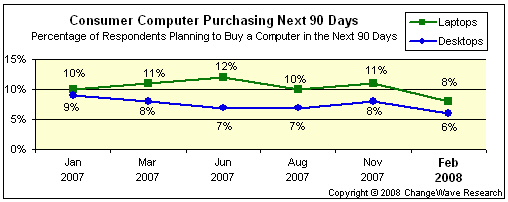
Consumers. Only 8% of the 4,427 consumers surveyed by ChangeWave in late February say they’ll be buying a laptop in the next 90 days – down 3-percentage points since November 2007. Most importantly, that’s a record low for the past 12 months.
The same trend was found for desktops, with just 6% saying they’ll be buying a one – also a low for the year.
Graph
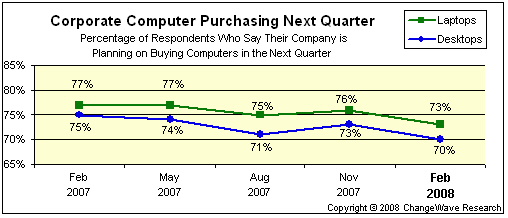
Businesses. In a double whammy, corporate PC buying has also slowed precipitously. In February, only 73% of 2,204 corporate respondents said their company plans on buying laptops in the next quarter – down 4-pts from a year ago. It’s the same pattern for desktops, with corporate purchases down 5-pts.
Graph
But what impact, if any, is the PC slowdown having on major manufacturers? Let’s look at three of the heavyweights:
Apple Mac Sales Remain Relatively Strong
Planned purchases of Apple (AAPL) computers remain relatively strong even in the slower PC buying environment.
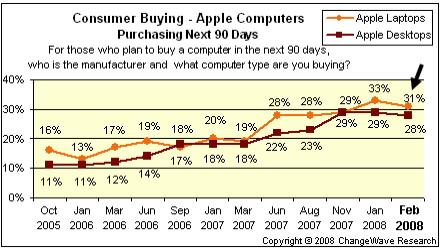
Looking at the next 90 days, Apple remains the leader among consumers who plan to buy a laptop (31%) – down just 2-pts from the all-time high recorded in our previous survey. Apple planned desktop purchases (28%; down 1-pt) are also near record levels.
Graph
Importantly, Apple’s planned buying numbers are up more than 50% from a year ago.
In the corporate market, planned Mac purchases for next quarter are also at near record highs, with laptops (7%) unchanged from previously and desktops (6%) down just 1-pt.
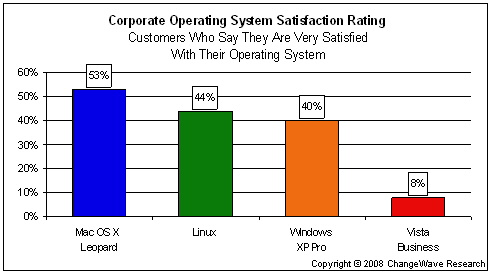
Most positively for Apple, the company continues to set the standard for customer satisfaction. Among corporate respondents using the Leopard operating system, better than half (53%) report they are Very Satisfied.
This compares to a 40% Very Satisfied rating for Windows XP Pro users, and a miniscule 8% Very Satisfied rating for Microsoft (MSFT) Vista Business (8%).
Graph
Another Ebb for Dell
In contrast to Apple, we find a far different story with Dell (DELL).
After experiencing a tiny uptick in planned consumer buying in our previous survey, Dell is once again losing traction going forward. Planned purchases of Dell laptops (28%; down 2-pts) and especially desktops (32%; down 4-pts) are considerably weaker than in our previous survey.
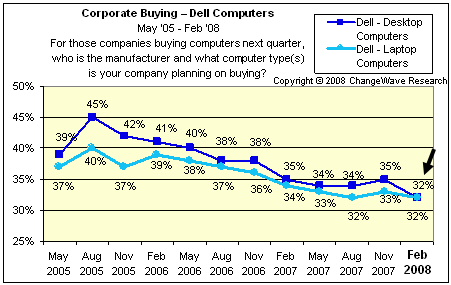
Dell is also plagued by a downturn in planned corporate buying for next quarter, with desktop (32%; down 3-pts) and laptop (32%; down 1-pt) purchases falling to new lows.
Graph
“It’s like déjà vu, all over again,” Yogi Berra famously said, and that’s what it looks like as Dell once again resumes its market share slide.
Weakening Sales for Hewlett-Packard
Another major player, Hewlett-Packard (HPQ), also exhibits weaker PC sales going forward – led by a big drop in consumer planned buying of desktops (18%; down 5-pts) and laptops (19%; down 2-pts).
In terms of corporate planned purchases, H-P also look weaker going forward, both for desktops (17%; down 1-pt) and laptops (14%; down 2-pts).
Hewlett-Packard recently announced strong computer sales. But almost 70% of its sales come from outside the U.S. – where the current slowdown is likely having less of an impact – while our ChangeWave surveys focus mainly on the U.S. market.
Indeed, outside the U.S., H-P registers higher market share numbers for consumer desktops (22%), corporate desktops (20%) and corporate laptops (17%).
Nonetheless, weaker U.S. visibility clearly looks to be an issue for Hewlett-Packard going forward.
Jim Woods co-wrote this article.
Tuesday, March 25, 2008
Luck, Deception and Incentives in Finance
From Martin Wolf at FT.com
Hardly a week goes by without the implosion of a hedge fund. Last week it was Carlyle Capital, with an astonishing $31 of debt for each dollar of equity. But we should not be surprised. These collapses are inherent in the hedge-fund model. It is even conceivable that this model will join securitised subprime mortgages on the scrap heap.
Getting away with producing adulterated milk is hard; getting away with an investment strategy that adds no value is not. That was the point made by John Kay, in a superb column last week (this page, March 11). With the “right” fee structure mediocre investment managers may become rich as they ensure that their investors cease to remain so.
Two distinguished academics, Dean Foster at the Wharton School of the University of Pennsylvania and Peyton Young of Oxford university and the Brookings Institution, explain the point beautifully*. They start by asking us to consider a rare event – that the stock market will fall by 20 per cent over the next 12 months, for example. They assume, too, that the options market prices this risk correctly, say at one in 10. An option costs $0.1 and pays out $1.
Now imagine that we set up a hedge fund with $100m from investors on the normal terms of 2 per cent management fees and 20 per cent of the return above a benchmark. We put our $100m in Treasury bills yielding 4 per cent. We also sell 100m covered options on the event, which nets us $10m. We put this $10m, too, in Treasury bills, which allows us to sell another 10m options. This nets another $1m. Then we go on holiday.
There is a 90 per cent chance that this bet will pay off in the first year. The fund then grosses $11m on the sale of the options, plus 4 per cent interest on the $110m in Treasury bills, for a handsome 15.4 per cent return. Our investors are delighted. Assume our benchmark was 4 per cent. We then earn $2m in management fees, plus 20 per cent of $11.4m, which amounts to over $4m gross. Whatever subsequently happens, we need never give this money back.
The chances are nearly 60 per cent that the bad event will not occur over five years. Since the fund is compounding at a rate of 11.4 per cent a year after fees, we will make well over $20m even if no new money is attracted into this apparently stellar enterprise. In the long run, however, the bad event is highly likely to occur. Since we have made huge profits, our investors have paid us handsomely for the near certainty of losing them money.
The immediate response may be that so naked a scam is inconceivable. Well, imagine a fund that leverages investors’ money by borrowing massively in short-term money markets in order to purchase higher-yielding paper. Assume, again, that the premium gives a correct estimate of the risk. With sufficient leverage, this fund, too, is likely to make profits for years. But it is also very likely to be wiped out, at some point. Does this strategy sound familiar? It certainly should by now.
We can identify two huge problems to be solved. First, many investment strategies have the characteristics of a “Taleb distribution”, after Nicholas Taleb, author of Fooled by Randomness. At its simplest, a Taleb distribution has a high probability of a modest gain and a low probability of huge losses in any period.
Second, the systems of reward fail to align the interests of managers with those of investors. As a result, the former have an incentive to exploit such distributions for their own benefit.
Professors Foster and Young argue that it is extremely hard to resolve these difficulties. It is particularly difficult to know whether a manager is skilful rather than lucky. In their telling example, the chances are more than 10 per cent that the fund will run for 20 years without being exposed. In other words, even after 20 years the outside investor cannot be confident that the results were not being generated by luck or a scam.
It is also tricky to align the interests of managers with those of investors. Obvious possibilities include rewarding managers on the basis of final returns, forcing them to hold a sizeable equity stake or levying penalties for underperformance.
None of these solutions solves the problem of distinguishing luck from skill. The first also encourages managers to take sizeable risks when they are close to the return at which payouts begin. Managers can evade the effects of the second alternative by taking positions in derivatives, which may be hard to police. Finally, even under the apparently attractive final alternative it appears that any clawback contract harsh enough to keep unskilled managers away will also discourage skilled ones.
It is obviously best not to pay the manager, as a manager, at all, but rather to invest alongside him, as at Berkshire Hathaway, Warren Buffett’s investment company. But we still have the challenge of knowing whether the manager is any good. We know this today of Mr Buffett. Fifty years ago, that would have been very hard to know.
What we have then is a huge “lemons” problem: in this business it is really hard to distinguish talented managers from untalented ones. For this reason, the business is bound to attract the unscrupulous and unskilled, just as such people are attracted to dealing in used cars (which was the original example of a market in lemons). The lemons theorem states that such markets are likely to disappear. The same may happen to today’s hedge-fund industry.
Now consider the financial sector as a whole: it is, again, hard either to distinguish skill from luck or to align the interests of management, staff, shareholders and the public. It is in the interests of insiders to game the system by exploiting the returns from higher probability events. This means that businesses will suddenly blow up when the low probability disaster occurs, as happened spectacularly at Northern Rock and Bear Stearns.
Moreover, if these unfavourable events – stock market crashes, mortgage failures, liquidity freezes – come in stampeding herds (because so many managers copy one another), they will say: “Nobody could have expected this, but, now that it has happened to all of us the government must come to the rescue.”
The more one believes this is how an unregulated financial system operates, the more worried one has to become. Rescue from this crisis may be on the way, but what about next time and the time after next?
Friday, March 7, 2008
Fears of Recession from Employment Data
U.S. recession fears mounted Friday as employment fell in February at its fastest rate in five years, suggesting that the housing and credit crunch is gripping the broader economy.
The data further cemented Wall Street expectations for additional Federal Reserve rate cuts when officials meet in less than two weeks and in the months that follow. Financial markets even raised their already aggressive rate-cut forecasts in the wake of the report. * From WSJ.com
Monday, January 28, 2008
Rollercoaster ride for global markets
So it's been a while since the last update, and The Economist captures it best: "it's rough out there."
The Fed cut interest rates 75bp last Tuesday in a surprise effort to stabilize US and global financial markets. This was in response to a broad sell-off in European and Asian markets last Monday, and was the first "intervention" between Fed meetings since September 11th. The 75bp cut was also the largest in a quarter century.
But while Bernanke is looking to calm markets that are reacting violently to the possibility of a major US recession, John Authers of FT.com notes that, in the coming weeks, better news about the economy could, paradoxically, "induce much more turmoil" in world markets. And so it seems that the rollercoaster ride might continue for US investors...
The Short View
By John Authers
Published: January 25 2008 02:00 | Last updated: January 25 2008 02:00
What would really throw a wrench into world markets? Remarkably, news that Société Générale, one of the biggest banks in Europe, had suffered a €5bn trading loss from the actions of a rogue trader was greeted as good news. European stocks rallied and US stocks stabilised (by recent standards).
Traders seemed reassured the huge sell-off earlier this week might have an explanation - even if it carried the disquieting implication that the Federal Reserve did not need to make its intervention on Tuesday.
No, what would really throw markets for a loop would be if the US could avoid a recession. And it now occurs to some traders that that might happen.
Initial jobless claims yesterday fell for the fourth week in a row. US employment data are notoriously unreliable but, if there is a wave of firings going on, it is well hidden.
Claims grew by two-thirds over a year as the last recession took hold - no such trend is at work now.
The jobless claims data prompted some analysts to revise their expectations for this month's non-farm payrolls, due next Friday - two days after a meeting of the Fed governors.
The chance of more extreme volatility - and possibly a true "bear market rally" - if jobless numbers are much better than expected is very high.
The market is retreating a little from its view that a cut of 50 basis points in the Fed funds rate is a certainty next week, largely because of this data. But if the US does avoid a recession, the implications go further.
Two-year Treasury yields have dipped from 5 per cent to 2 per cent in barely six months. If the economy survives unscathed, there is potential for grievous losses in that market. And, of course, world equities would have to unwind many trades of the past three weeks.
So good economic news from the US could yet induce much more turmoil than the actions of an irresponsible trader in Paris.
www.ft.com/shortview
Copyright The Financial Times Limited 2008
Friday, January 4, 2008
Market Update
The major indexes moved sharply lower Friday morning. The Dow dropped below 13000 for the first time in a long time. As it stands now, the S&P is only up about 2% from the start of 2007. What is going on? It seems that fears that we may be headed towards recession, or are already in one, are getting priced into the equity markets, echoing the sentiment of the debt market. Jobs data came in, and showed that the economy had added the fewest number of jobs since August 2003, when the economy recovering from a recession. Yesterday, data came in which showed that the manufacturing sector, which had been holding strong, was weakening considerably. Car manufacturers, for example, reported a 3% drop in sales of cars and light trucks in December. All told, not a pretty picture for the real economy. Investors seem to be abandoning the hope that the turmoil would be limited to the financial markets.
While many expect a rate cut from the Fed at their next meeting at the end of the month, they may not be able to cut rates as far as they did in 2001. Surging commodities prices, caused in part by increasing demand from the developing world, turmoil in resource rich countries, and the increasing use of corn to make ethanol, have created significant inflationary pressure, as higher input prices trickle down throughout the economy.
But all is not lost. It is still possible that economies in the developing world, and to a lesser extent in Europe, will remain robust and help limit the downside to the US economy, and to American investors. The risk is that the theory of "decoupling," which asserts that financial markets are no longer tied to each other as strongly as they once were, does not pan out, and that weakness in America will spread to the rest of the world.
It will be fun to watch from the sidelines.