Friday, April 18, 2008

Easy Spirits

The weather in Brunswick is outrageously gorgeous today, and good spirits are easy to find. It seems that the case is the same on Wall St. Over the past few weeks, the mood on the Street seems to have taken a turn towards optimism. Many CEOs of the top banks--with the notable exception of Jamie Dimon at JPMorgan, have expressed a belief that "the worse is over." A favorable earnings season, especially for technology companies, has contributed to this sentiment. But, with credit spreads still high, it is clear that not all share this view. There are many reasons for continued pessimism--not least of which is the fact that systemic leverage has not down nearly enough to be realigned with historical averages. If consumers are forced to unwind, they spending will abate, with negative consequences for corporations, especially those burdened with considerable debt. Is the crisis near its end? Or has it barely begun? Time will tell...

Sunday, March 30, 2008

Update on PC Market

We looked at PC manufacturers in the fall. Since we last talked, economic sentiment has changed tremendously. Here is an update on how the three big manufacturers are doing. From SeekingAlpha.com

U.S. consumers and businesses aren’t buying PCs like they used to – and the economic slowdown continues to take a big bite out of personal computer demand.

Two recent ChangeWave surveys focused on PC purchasing trends among consumers and corporations. The results clearly show deteriorating PC spending going forward.

Next 90 Days: PCs Head South

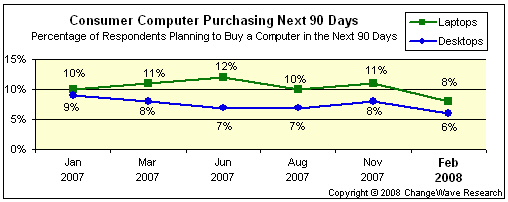
Consumers. Only 8% of the 4,427 consumers surveyed by ChangeWave in late February say they’ll be buying a laptop in the next 90 days – down 3-percentage points since November 2007. Most importantly, that’s a record low for the past 12 months.

The same trend was found for desktops, with just 6% saying they’ll be buying a one – also a low for the year.

Graph

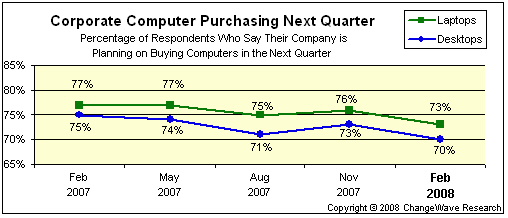
Businesses. In a double whammy, corporate PC buying has also slowed precipitously. In February, only 73% of 2,204 corporate respondents said their company plans on buying laptops in the next quarter – down 4-pts from a year ago. It’s the same pattern for desktops, with corporate purchases down 5-pts.

Graph

But what impact, if any, is the PC slowdown having on major manufacturers? Let’s look at three of the heavyweights:

Apple Mac Sales Remain Relatively Strong

Planned purchases of Apple (AAPL) computers remain relatively strong even in the slower PC buying environment.

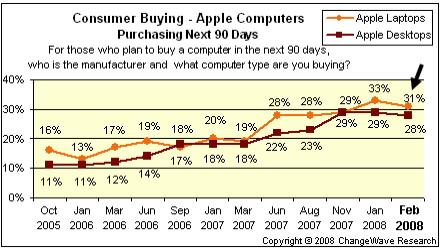
Looking at the next 90 days, Apple remains the leader among consumers who plan to buy a laptop (31%) – down just 2-pts from the all-time high recorded in our previous survey. Apple planned desktop purchases (28%; down 1-pt) are also near record levels.

Graph

Importantly, Apple’s planned buying numbers are up more than 50% from a year ago.

In the corporate market, planned Mac purchases for next quarter are also at near record highs, with laptops (7%) unchanged from previously and desktops (6%) down just 1-pt.

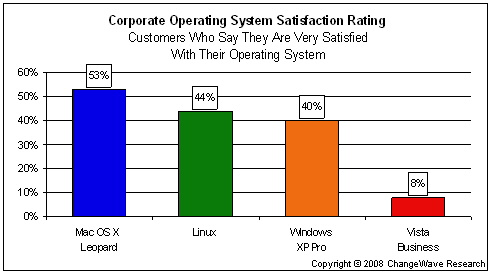
Most positively for Apple, the company continues to set the standard for customer satisfaction. Among corporate respondents using the Leopard operating system, better than half (53%) report they are Very Satisfied.

This compares to a 40% Very Satisfied rating for Windows XP Pro users, and a miniscule 8% Very Satisfied rating for Microsoft (MSFT) Vista Business (8%).

Graph

Another Ebb for Dell

In contrast to Apple, we find a far different story with Dell (DELL).

After experiencing a tiny uptick in planned consumer buying in our previous survey, Dell is once again losing traction going forward. Planned purchases of Dell laptops (28%; down 2-pts) and especially desktops (32%; down 4-pts) are considerably weaker than in our previous survey.

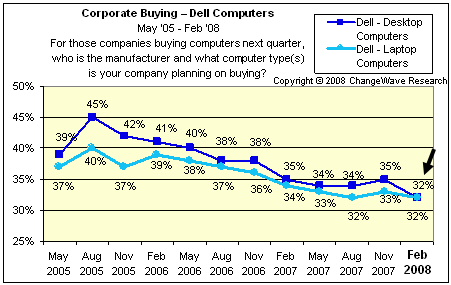
Dell is also plagued by a downturn in planned corporate buying for next quarter, with desktop (32%; down 3-pts) and laptop (32%; down 1-pt) purchases falling to new lows.

Graph

“It’s like déjà vu, all over again,” Yogi Berra famously said, and that’s what it looks like as Dell once again resumes its market share slide.

Weakening Sales for Hewlett-Packard

Another major player, Hewlett-Packard (HPQ), also exhibits weaker PC sales going forward – led by a big drop in consumer planned buying of desktops (18%; down 5-pts) and laptops (19%; down 2-pts).

In terms of corporate planned purchases, H-P also look weaker going forward, both for desktops (17%; down 1-pt) and laptops (14%; down 2-pts).

Hewlett-Packard recently announced strong computer sales. But almost 70% of its sales come from outside the U.S. – where the current slowdown is likely having less of an impact – while our ChangeWave surveys focus mainly on the U.S. market.

Indeed, outside the U.S., H-P registers higher market share numbers for consumer desktops (22%), corporate desktops (20%) and corporate laptops (17%).

Nonetheless, weaker U.S. visibility clearly looks to be an issue for Hewlett-Packard going forward.

Jim Woods co-wrote this article.

Tuesday, March 25, 2008

Luck, Deception and Incentives in Finance

From Martin Wolf at FT.com

Hardly a week goes by without the implosion of a hedge fund. Last week it was Carlyle Capital, with an astonishing $31 of debt for each dollar of equity. But we should not be surprised. These collapses are inherent in the hedge-fund model. It is even conceivable that this model will join securitised subprime mortgages on the scrap heap.

Getting away with producing adulterated milk is hard; getting away with an investment strategy that adds no value is not. That was the point made by John Kay, in a superb column last week (this page, March 11). With the “right” fee structure mediocre investment managers may become rich as they ensure that their investors cease to remain so.

Two distinguished academics, Dean Foster at the Wharton School of the University of Pennsylvania and Peyton Young of Oxford university and the Brookings Institution, explain the point beautifully*. They start by asking us to consider a rare event – that the stock market will fall by 20 per cent over the next 12 months, for example. They assume, too, that the options market prices this risk correctly, say at one in 10. An option costs $0.1 and pays out $1.

Now imagine that we set up a hedge fund with $100m from investors on the normal terms of 2 per cent management fees and 20 per cent of the return above a benchmark. We put our $100m in Treasury bills yielding 4 per cent. We also sell 100m covered options on the event, which nets us $10m. We put this $10m, too, in Treasury bills, which allows us to sell another 10m options. This nets another $1m. Then we go on holiday.

There is a 90 per cent chance that this bet will pay off in the first year. The fund then grosses $11m on the sale of the options, plus 4 per cent interest on the $110m in Treasury bills, for a handsome 15.4 per cent return. Our investors are delighted. Assume our benchmark was 4 per cent. We then earn $2m in management fees, plus 20 per cent of $11.4m, which amounts to over $4m gross. Whatever subsequently happens, we need never give this money back.

The chances are nearly 60 per cent that the bad event will not occur over five years. Since the fund is compounding at a rate of 11.4 per cent a year after fees, we will make well over $20m even if no new money is attracted into this apparently stellar enterprise. In the long run, however, the bad event is highly likely to occur. Since we have made huge profits, our investors have paid us handsomely for the near certainty of losing them money.

The immediate response may be that so naked a scam is inconceivable. Well, imagine a fund that leverages investors’ money by borrowing massively in short-term money markets in order to purchase higher-yielding paper. Assume, again, that the premium gives a correct estimate of the risk. With sufficient leverage, this fund, too, is likely to make profits for years. But it is also very likely to be wiped out, at some point. Does this strategy sound familiar? It certainly should by now.

We can identify two huge problems to be solved. First, many investment strategies have the characteristics of a “Taleb distribution”, after Nicholas Taleb, author of Fooled by Randomness. At its simplest, a Taleb distribution has a high probability of a modest gain and a low probability of huge losses in any period.

Second, the systems of reward fail to align the interests of managers with those of investors. As a result, the former have an incentive to exploit such distributions for their own benefit.

Professors Foster and Young argue that it is extremely hard to resolve these difficulties. It is particularly difficult to know whether a manager is skilful rather than lucky. In their telling example, the chances are more than 10 per cent that the fund will run for 20 years without being exposed. In other words, even after 20 years the outside investor cannot be confident that the results were not being generated by luck or a scam.

It is also tricky to align the interests of managers with those of investors. Obvious possibilities include rewarding managers on the basis of final returns, forcing them to hold a sizeable equity stake or levying penalties for underperformance.

None of these solutions solves the problem of distinguishing luck from skill. The first also encourages managers to take sizeable risks when they are close to the return at which payouts begin. Managers can evade the effects of the second alternative by taking positions in derivatives, which may be hard to police. Finally, even under the apparently attractive final alternative it appears that any clawback contract harsh enough to keep unskilled managers away will also discourage skilled ones.

It is obviously best not to pay the manager, as a manager, at all, but rather to invest alongside him, as at Berkshire Hathaway, Warren Buffett’s investment company. But we still have the challenge of knowing whether the manager is any good. We know this today of Mr Buffett. Fifty years ago, that would have been very hard to know.

What we have then is a huge “lemons” problem: in this business it is really hard to distinguish talented managers from untalented ones. For this reason, the business is bound to attract the unscrupulous and unskilled, just as such people are attracted to dealing in used cars (which was the original example of a market in lemons). The lemons theorem states that such markets are likely to disappear. The same may happen to today’s hedge-fund industry.

Now consider the financial sector as a whole: it is, again, hard either to distinguish skill from luck or to align the interests of management, staff, shareholders and the public. It is in the interests of insiders to game the system by exploiting the returns from higher probability events. This means that businesses will suddenly blow up when the low probability disaster occurs, as happened spectacularly at Northern Rock and Bear Stearns.

Moreover, if these unfavourable events – stock market crashes, mortgage failures, liquidity freezes – come in stampeding herds (because so many managers copy one another), they will say: “Nobody could have expected this, but, now that it has happened to all of us the government must come to the rescue.”

The more one believes this is how an unregulated financial system operates, the more worried one has to become. Rescue from this crisis may be on the way, but what about next time and the time after next?

Friday, March 7, 2008

Fears of Recession from Employment Data

U.S. recession fears mounted Friday as employment fell in February at its fastest rate in five years, suggesting that the housing and credit crunch is gripping the broader economy.

The data further cemented Wall Street expectations for additional Federal Reserve rate cuts when officials meet in less than two weeks and in the months that follow. Financial markets even raised their already aggressive rate-cut forecasts in the wake of the report. * From WSJ.com

Monday, January 28, 2008

Rollercoaster ride for global markets

So it's been a while since the last update, and The Economist captures it best: "it's rough out there."

The Fed cut interest rates 75bp last Tuesday in a surprise effort to stabilize US and global financial markets. This was in response to a broad sell-off in European and Asian markets last Monday, and was the first "intervention" between Fed meetings since September 11th. The 75bp cut was also the largest in a quarter century.

But while Bernanke is looking to calm markets that are reacting violently to the possibility of a major US recession, John Authers of FT.com notes that, in the coming weeks, better news about the economy could, paradoxically, "induce much more turmoil" in world markets. And so it seems that the rollercoaster ride might continue for US investors...

The Short View
By John Authers
Published: January 25 2008 02:00 | Last updated: January 25 2008 02:00
What would really throw a wrench into world markets? Remarkably, news that Société Générale, one of the biggest banks in Europe, had suffered a €5bn trading loss from the actions of a rogue trader was greeted as good news. European stocks rallied and US stocks stabilised (by recent standards).

Traders seemed reassured the huge sell-off earlier this week might have an explanation - even if it carried the disquieting implication that the Federal Reserve did not need to make its intervention on Tuesday.

No, what would really throw markets for a loop would be if the US could avoid a recession. And it now occurs to some traders that that might happen.

Initial jobless claims yesterday fell for the fourth week in a row. US employment data are notoriously unreliable but, if there is a wave of firings going on, it is well hidden.

Claims grew by two-thirds over a year as the last recession took hold - no such trend is at work now.

The jobless claims data prompted some analysts to revise their expectations for this month's non-farm payrolls, due next Friday - two days after a meeting of the Fed governors.

The chance of more extreme volatility - and possibly a true "bear market rally" - if jobless numbers are much better than expected is very high.

The market is retreating a little from its view that a cut of 50 basis points in the Fed funds rate is a certainty next week, largely because of this data. But if the US does avoid a recession, the implications go further.

Two-year Treasury yields have dipped from 5 per cent to 2 per cent in barely six months. If the economy survives unscathed, there is potential for grievous losses in that market. And, of course, world equities would have to unwind many trades of the past three weeks.

So good economic news from the US could yet induce much more turmoil than the actions of an irresponsible trader in Paris.

www.ft.com/shortview

Copyright The Financial Times Limited 2008

Friday, January 4, 2008

Market Update

The major indexes moved sharply lower Friday morning. The Dow dropped below 13000 for the first time in a long time. As it stands now, the S&P is only up about 2% from the start of 2007. What is going on? It seems that fears that we may be headed towards recession, or are already in one, are getting priced into the equity markets, echoing the sentiment of the debt market. Jobs data came in, and showed that the economy had added the fewest number of jobs since August 2003, when the economy recovering from a recession. Yesterday, data came in which showed that the manufacturing sector, which had been holding strong, was weakening considerably. Car manufacturers, for example, reported a 3% drop in sales of cars and light trucks in December. All told, not a pretty picture for the real economy. Investors seem to be abandoning the hope that the turmoil would be limited to the financial markets.

While many expect a rate cut from the Fed at their next meeting at the end of the month, they may not be able to cut rates as far as they did in 2001. Surging commodities prices, caused in part by increasing demand from the developing world, turmoil in resource rich countries, and the increasing use of corn to make ethanol, have created significant inflationary pressure, as higher input prices trickle down throughout the economy.

But all is not lost. It is still possible that economies in the developing world, and to a lesser extent in Europe, will remain robust and help limit the downside to the US economy, and to American investors. The risk is that the theory of "decoupling," which asserts that financial markets are no longer tied to each other as strongly as they once were, does not pan out, and that weakness in America will spread to the rest of the world.

It will be fun to watch from the sidelines.


Friday, December 28, 2007

What's next?

The recent credit turmoil was started by early signs of trouble in the sub-prime mortgage market. While there may still be surprises ahead, the markets seem to have already priced in much downside potential in that market. However, what if default rates start rising in the corporate loan markets, which have been securitized in much the same way as the housing market? Of course, spreads have already increased significantly for that market, but it is possible that things could get significantly worse. Here is an interesting article from the NY Times:

What if it’s not just subprime?

As 2007 ends, it seems that the financial world shakes every time a company reveals some new exposure to the disastrous world of subprime mortgage lending.

But just how different was subprime lending from other lending in the days of easy money that prevailed until this summer? The smug confidence that nothing could go wrong, and that credit quality did not matter, could be seen in the many other markets as well.

That was particularly true in the corporate loan market. Loans were cheap, and anyone worried about losses could buy insurance for almost nothing. It was not an environment that encouraged careful lending.

“The severity of the subprime debacle may be only a prologue to the main act, a tragedy on the grand stage in the corporate credit markets,” Ted Seides, the director of investments at Protégé Partners, a hedge fund of funds, wrote in Economics & Portfolio Strategy.

“Over the past decade, the exponential growth of credit derivatives has created unprecedented amounts of financial leverage on corporate credit,” he added. “Similar to the growth of subprime mortgages, the rapid rise of credit products required ideal economic conditions and disconnected the assessors of risk from those bearing it.”

There are differences, of course, and they may be critical in averting a crisis. To start, there are virtually no defaults in corporate lending now, and even if Moody’s is accurate in its forecast that defaults will quadruple in 2008, the default rate on speculative loans and bonds would still be below the long-term average. That hardly sounds like a crisis.

And there is no reason to think that fraud was a big factor in the corporate loan market, as it seems to have been in subprime.

But the history of junk bonds provides a warning that defaults start to rise a few years after credit gets very easy. By that standard, says Martin Fridson of the research firm FridsonVision, a new wave of defaults is overdue. Already, even without defaults, he says, about a tenth of high-yield bonds are trading at distress levels — levels that provide yields of at least 10 percentage points more than Treasuries.

If a recession does occur, one can easily foresee a wave of defaults in junk bonds and their bank-loan cousins, leveraged loans. With highly leveraged structures supported by some of those loans, the surprises could be greater. It is sobering to realize that the issuing of leveraged loans set a record in 2007, even though the market contracted sharply late in the year.

If this was the year that many readers — not to mention financial reporters — learned what C.D.O., M.B.S. and SIV stood for, 2008 could be the year of C.D.S. and C.L.O. (For those who came in late, those abbreviations from 2007 are shorthand for collateralized debt obligations, mortgage-backed securities and structured investment vehicles. The new ones are credit default swaps and collateralized loan obligations — a special kind of C.D.O. backed by corporate loans.)

We have learned in the last month that credit insurers took big risks in backing C.D.O.’s and other exotic things. Some are scrambling to raise more capital to stay in business. One, ACA, may well go out of business.

But if the credit insurers turn out to have had inadequate reserves, what are we to make of the credit default swap market? Mr. Seides calls it “an insurance market with no loss reserves,” and points out that $45 trillion in such swaps are now outstanding. That is, he notes, almost five times the United States national debt.

Many of those swaps cancel each other out — or will if everyone meets their obligations. The big banks say they run balanced books, in which they sell insurance to one customer and buy insurance on the same borrower from another customer. But if some customers cannot pay what they owe, this could be another shock for bank investors. As it is, financial stocks have underperformed other stocks by record amounts this year.

One of the more remarkable facts about the subprime crisis is that total losses to the financial system may be about equal to the amount of subprime loans that were issued. On the face of it, that appears absurd, since many such loans will be paid off, and those that default will not be total losses. But, Mr. Seides said in an interview, “the financial leverage placed on the underlying assets was so high” that the losses multiplied, as the profits did when times were good.

“When there is more leverage” and things go wrong, he said, “there are more losses.”

The corporate credit market is vastly larger than the subprime market, and there are plenty of dubious loans outstanding that probably could not be refinanced in the current market. If some of those companies run into problems, defaults could soar and fears about C.L.O. valuations and C.D.S. defaults could spread long before there are large actual losses on loans.

There are other areas of potential weakness in 2008. Commercial real estate is one area where some see disaster looming. Others worry that some emerging markets could run into big problems because many borrowers there have taken out loans denominated in foreign currency and could be devastated if local currencies lose value.

It was the greatest credit party in history, made possible by a new financial architecture that moved much of the activities out of regulated institutions and into financial instruments that emphasized leverage over safety. The next year may be the one when we learn whether the subprime crisis was a relatively isolated problem in that system, or just the first indication of a systemic crisis.

Friday, December 21, 2007

Can't be picky...

Here is an interesting article about the cash infusions that many Wall St. firms have been receiving from the state run investment funds of oil-rich and asian countries. What is interesting is that it appears that many of these funds expressed an interest in investing in American financial institutions a few months ago, but were rebuffed.

Temasek in talks to take Merrill stake
By Sundeep Tucker in Hong Kong

Published: December 21 2007 09:23 | Last updated: December 21 2007 09:23

Merrill Lynch is in “preliminary” talks with Singapore’s Temasek that could result in the US bank becoming the latest Wall Street titan to receive a significant cash injection from a sovereign wealth fund.

A person familiar with the matter on Friday said that the two sides had held discussions in New York in recent weeks about a potential multi-billion dollar investment by the Singapore state investment agency.

EDITOR’S CHOICE
Lex: Temasek joins the Wall Street party - Dec-21Ex-NYSE colleague joins Thain at Merrill - Dec-04Stefan Stern: Lessons of a bloody transition - Dec-03Merrill’s new chief eyes overhaul - Dec-02Transatlantic challenge for new NYSE boss - Dec-02Bankers’ bonuses require creativity - Dec-02Citigroup, UBS and Morgan Stanley have each sold large amounts of equity to sovereign wealth funds in the Middle East and Asia in recent weeks to bolster balance sheets that have been battered by losses relating to US subprime mortgages.

“Merrill and Temasek have been talking for a while about this although there are no indications that a deal is imminent,” said the person.

In October Merrill announced $8.4bn worth of writedowns on mortgage-related investments and corporate loans, and the departure of Stan O’Neal, its long-serving chief executive.

Some analysts predict that Merrill will announce an additional $8bn writedown when it unveils its fourth-quarter results in mid-January.

The US bank’s stock price has nearly halved this year, cutting its market capitalisation to around $47bn. Dealmakers believe that Merrill would be comfortable with Temasek taking a stake of around 10 per cent, should a deal materialise.

Merrill Lynch and Temasek on Friday declined to comment.

Morgan Stanley this week announced that it is to receive a $5bn capital injection from China Investment Corporation, having disclosed a total writedown in the fourth quarter of $9.4bn following a disastrous subprime bet.

Last week UBS took nearly $10bn from the Government of Singapore Investment Corp, a sister sovereign wealth fund of Temasek, while Citigroup last month received $7.5bn from the Abu Dhabi Investment Authority.

The deals have underlined the growing importance of sovereign wealth funds in the Middle East and Asia, and their increasingly bold moves to take advantage of the need for capital among western institutions.

The three deals have yet to be endorsed or scrutinised by shareholders of the investment banks. The Financial Times reported on Friday that UBS is facing a shareholder revolt over its planned re-capitalisation deal with GIC and a mystery investor based in Saudi Arabia.

Thursday, December 20, 2007

Momentum Lost


It took a little longer than we thought it would, but the markets did lose much of the momentum they had at the start of the month, and now appear to be sliding regardless of positive news. Traditionally, there is a "Santa Claus" rally at the end of the year. Will we seen one this time arond? Tell us your thoughts!

Friday, December 7, 2007

Value vs. Liquidity in times of systemic stress

Throughout the recent market instability, one topic that is constantly discussed is price discovery in markets. Public exchanges work by matching buyers and sellers, and they determine prices based on supply and demand. In this way, the price of a certain security should also represent its present "fair" value to the investor. Yet in times of financial crises, this relationship can break down due to insolvency. Bookstaber does a great job explaining this situation, and also provides some insight into the implications of "liquidity" vs. "value" pricing on the rest of the market:

Read his blog here.

Rick Bookstaber is the author of A Demon of Our Own Design, which discusses risk management in the context of financial crises. Bookstaber argues that financial innovation is inevitable, and that, although complexity is not necessarily bad for the markets, it ultimately encourages financial crises. His blog follows up on these concepts and applies it to current events in the markets.

Friday, November 30, 2007

Big Rally

The markets have rallied in a big way over the past few days, in large part due to comments by the Fed which suggested that they will cut rates again at their next meeting, as well as lower oil prices. Financials rose today on news that the Bush administration and some financial institutions were near a deal to temporarily freeze interest rates on certain subprime home loans, which may help stem a tide of foreclosures as many subprime mortgages are scheduled to "reset" to higher rates. Markets seemed to shake off disappointing consumer spending data which suggests that the financial turmoil may be spreading to the real economy.
 
The market has been incredibly volatile in the last few weeks, highlighting the fact that markets can often appear to be irrational. It sure has been fun to watch, here on the sidelines. It seems as though the markets over reacted in the last couple of days.  We expect that they will lose much of their recent gains by early next week.

Wednesday, November 28, 2007

Draining away: four problems that could beset debt markets for years

http://www.ft.com/cms/s/0/aeb5d6ae-9d13-11dc-af03-0000779fd2ac.html?nclick_check=1

By Gillian Tett

Published: November 27 2007 19:06 | Last updated: November 27 2007 19:06

Bill Gross, chief investment officer of Pimco, the world's largest bond fund, has in recent years become famous for issuing downbeat warnings about the credit world. This month, however, his tone has turned positively apocalyptic.

"We haven't faced a downturn like this since the Depression," he observed to reporters when talking about the US housing sector and its impact. The debt market's "effect on consumption, its effect on future lending attitudes, could bring [America] close to the zero line in terms of economic growth", he said. "It does keep me up at night."

By Wall Street standards, such sentiments still sound extreme: in public, at least, most financiers are still anxious to avoid any comparisons with the terrible 1930s. Nevertheless, behind the scenes a mood of gloom is spreading across Wall Street and other parts of the financial world.

Until quite recently, many bankers and policymakers hoped that this summer's credit squeeze would prove short-lived. But as winter draws in, bankers and regulators are coming to recognise that the shock that arrived in August could be merely the first chapter in a saga of pain that could last years.

As a result, investor confidence is slipping and, with banks wary of lending to each other, borrowing costs in the money markets are on the rise (see chart). While these price swings may be exaggerated by the looming turn of the year – a period when banks typically hoard cash to flatter their annual accounts – the underlying trend is clearly alarming the authorities. In recent days the European Central Bank, the Bank of Canada and the US Federal Reserve have all acted to pump liquidity into the interbank market in an effort to keep that crucial corner of the financial system from seizing up.

"The liquidity stresses in global money markets are palpable," says Donal O'Mahony, analyst at Davy, the Irish stockbroker. Or as John Hurley, a member of the ECB's governing council, observed on Tuesday: "Recent developments have not been favourable and increase the risk of a more significant spillover from financial markets to broader economic activity." Markets may therefore "continue to remain fragile" for some time.

Dollar & euro Libor spreads

This climate of fear reflects four inter-related problems. First, projected losses from this year's credit turmoil are continuing to rise. When it first became clear that US homeowners were defaulting on their mortgages, particularly in the so-called subprime category of borrowers with a poor credit history, Ben Bernanke, the Fed chairman, suggested this would create $50bn (£24.1bn, €33.6bn) in losses. But this month he raised the projected loss to $150bn – and many investment banks fear it will be at least twice this size.

That is partly because house prices are falling faster than economists expected but also because lending standards had been far more lax than previously thought. Indeed, standards were so loose that Goldman Sachs analysts now think that total losses on US subprime mortgages issued in 2006 and early 2007 will be as high as 22 cents in the dollar.

If that projection is bad, however, there is worse. As defaults rise on subprime mortgages, other types of debt, such as on credit cards and in car loans, also begin to face defaults. "Investors are now starting to worry that the subprime crisis will broaden out into other forms of consumer and real estate lending," notes Goldman Sachs in a recent research report, which estimates that in a worst-case scenario non-subprime losses could eventually rise as high as $445bn.

If so, this would imply America could be heading for a total credit hit of $700bn or so – and that is without taking account of any losses that might occur if risky corporate loans turn sour too. This is a dramatically bigger shock than investors expected back in August and much larger than the losses in America's last banking shock, the savings and loans crisis of the 1980s. The Goldman team's worst case is not far from the scale of losses produced by Japan's 1990s banking crisis, where bad loans were estimated at $800bn-$1,000bn.

US banks CDS prices

A blow of this scale could take years to absorb. But aside from its size, there is a second feature of the credit crisis now spooking investors: uncertainty about how the credit pain will affect the financial system as a whole. In previous crises, credit losses were usually relatively well contained: in the S&L debacle, for example, bad loans were held by a limited group of US banks, which were well known to regulators.

But the feverish financial innovation seen this decade has enabled banks to turn corporate and consumer loans into securities that have then been sold all over the world. Until recently it was presumed that this innovation had made banks stronger than before, because they had passed credit risk on to others. Consequently, regulators and investors tended to presume that the main threats to stability in the modern financial world came not from banks but risk-loving players such as hedge funds. Recent events have, however, turned these assumptions on their head. Although some hedge funds have run into problems, their losses have generally not posed any wider systemic threat. Instead, share prices of the banking groups have slid as it became clear that banks had offloaded less risk from their books as investors and regulators had presumed. Indeed, the interbank market is gripped by fears that more banks could soon tumble into crisis, as they run out of capital with which to write off loans.

Sectors that had been widely ignored in recent years because they seemed utterly safe and dull – such as bond insurers, money market funds and structured investment vehicles – are also beset by a loss of confidence.

The revelations are making investors fearful about the potential for unexpected chain reactions to develop as complex interlinkages break down in poorly understood corners of the financial world. "Grenades keep going off in the system and nobody quite knows what to think or expect," says one policymaker. "There is a fear of the unknown [risks]."

Aside from this abstract fear, there is also a very tangible concern about which institutions are suffering subprime pain. In recent weeks, large western banks and other financial institutions have written off about $50bn of credit losses. But analysts fear that the coming year-end statements from US banks – and future reports from European banks – could reveal more bad news. Many also suspect that non-bank institutions, such as insurance companies and asset managers, are also holding large losses that have yet to appear. "If mortgage-related losses are $400bn-plus, then banks probably only have a portion," says Geraud Charpin at UBS.

Dollar swap spread

These financial interlinkages, in turn, are fuelling a third concern: the knock-on impact of the credit turmoil on the "real" economy. When the credit crisis first emerged this summer, many economists initially thought it would have limited impact on US growth. Some cited parallels with the events of 1998 surrounding Long Term Capital Management, a hedge fund that imploded: that an event shocked Wall Street but barely affected the wider American economy, let alone that of the world.

But it is now clear that the 2007 credit shock has implications that extend well beyond hedge funds or Wall Street. As the credit losses pile up, the banks' capital resources are being squeezed – and that is forcing them to cut lending, particularly to riskier companies and consumers.

If the process intensifies – and many analysts fear it will – that would undermine economic growth. In turn, this could unleash a second, more pernicious phase of the credit shock: defaults in the corporate arena of the type that have not been seen in the credit squeeze so far. That could, moreover, generate a further round of losses on credit instruments and thus more pain for banks and other investors.

"Three months ago it was reasonable to expect that the subprime credit crisis would be a financially significant event but not one that would threaten the overall pattern of economic growth," Lawrence Summers, former US Treasury secretary, wrote in the Financial Times this week. However, "the odds now favour a US recession that slows growth significantly on a global basis".

Not everybody accepts this downbeat scenario. After all, one mitigating feature of the current market turmoil is that it is occurring after a period of strong global growth – and, in particular, at a time when regions outside the US, such as the emerging economies, continue to boom.

Corporate earnings in the US and Europe remain strong and American consumers do not appear to be panicking: though housing activity is weak, retail sales last Friday – the bellwether post-Thanksgiving shopping day – were relatively strong. For October they were up 5.2 per cent year-on-year.

Many investors also take comfort from a hope that the Fed will slash interest rates to offset any risk of a serious economic downturn. The US bond market, for example, is trading at levels that assume several more rate cuts – totalling at least a full percentage point – before next autumn. "We expect the US and global economy to slow but avoid a serious downturn," say economists at Lehman Brothers, who argue that a recession will be avoided "by central banks changing course".

Nevertheless, the longer the credit squeeze lasts, the greater the risk that the pain will spread from Wall Street to Main Street. If such contagion does occur, there is a fourth problem increasingly alarming investors: a dawning realisation that western authorities have few policy tools with which to resist this spreading financial shock.

Indeed, in the current environment the Fed appears distinctly reluctant to cut rates to the degree that the bond market expects, because inflation pressures are rising. Data on Wednesday are expected to show that inflationary pressures are rising in Europe too, which could also stay the ECB's hand on rates. Even if central banks do eventually throw caution to the winds and slash rates, this may not be enough to ease the problems of the markets. "Rate cuts are part of the solution but probably only just a part of it," observes UBS's Mr Charpin.

That is because this year's shock has, in essence, shattered investor faith in the innovative techniques that have enabled the global banking system to create a wave of cheap credit in recent years.

Investor trust is likely to return only once there is real transparency about existing problems – and when a rethink has taken place of the way that 21st-century finance is done.

At the best of times, these would appear to be difficult tasks; in the current, panicky climate they seem doubly hard – and the steps needed to rebuild investor faith cannot be implemented quickly, however desperately the market might be clamouring for comfort.

"I think we are going to go through next year, certainly the first half of next year, with considerable traumas," Peter Sutherland, chairman of both Goldman Sachs International and BP, said this week. "It is a dangerous period for the world."


Monday, November 26, 2007

So much for the see-saw....Markets Panic

Stocks Enter a 'Correction'[intraday-112607_2.jpg]

The Dow industrials tumbled 237.44, or 1.8%, to 12743.44 after trading up and down throughout the morning as fears of a credit squeeze and economic downturn pushed the industrials into a "correction," down 10% from their October peak of 14164.53. The yield on the 10-year Treasury note sank well below 4%, in a sign of a flight to safety. Spreads on junk bonds are higher than they were during the August credit crisis. Will we see a quick rebound tomorrow, as has been the pattern after days of panic so far this year? It's probably a sign of rough seas ahead if the markets don't recover in the next few days...Stay tuned.

Yikes! Briefs from a See-Saw Market


Markets expect a recession--WSJ Article

Citigroup to fire 45,000 people! --That's a lot of people, people. (That's more than 10% of Citi's 327,000 strong workforce).

HSBC is taking the SIV it controls onto its balance sheet in order to prevent a margin call and a firesale of good assets, which could send valuations tumbling. This means that they are assuming about $35 Billion in risk, which, for one of the worlds biggest banks, is not a huge deal--is this the way forward? What are the consequences for other banks who have much more exposure, relative to their balance sheets?

This guy shows that you can make a lot of money in a crisis. His hedge fund had returned over 1000% so far this year. Some interesting tidbits from his letter to investors.

Monday, November 19, 2007

Return of Credit Jitters

Big losses on Wall St today, as investors reacted in a big way to the downgrade of Citi by a Goldman analyst, who warned of further write-downs on collateralized securities. Lowe's, the home improvement store released another round of disappointing results, which exacerbated fears that the real estate market will get worse before getting better. HP announced a big increase in revenue, mainly as a result of increased sales in China. While the stock was dragged down by the rest of the market during the day, it is trading ahead of yesterday's closing price in after-hours trading. However, investors questioned whether global growth, especially in China, will be able to buffer American companies from a domestic downturn, as Chinese officials announced a freeze on bank lending aimed at curbing an investment boom that threatens to overheat the economy in that country.

From the WSJ:


Stocks took a beating Monday, with the Dow Jones Industrial Average falling below 13000, as two old culprits -- financials and housing -- contributed to the market's widespread distaste for equities.

"We are seeing a continuation of the unwinding of investor optimism that we have been seeing since October," said Chris Johnson, chief executive of Johnson Research Group in Cincinnati.

All three major indexes were down more than 1% and decliners outnumbered advancers on both the New York Stock Exchange and the Nasdaq Composite Index by about five to one.

Citigroup was among the stocks casting the longest shadow over the market. The giant bank's shares dropped 5.8% after Goldman Sachs analyst William F. Tanona cut the stock to "sell" from "neutral" and estimated that Citigroup faces $15 billion in write-downs on collateralized debt obligations over the next two quarters.

Citi's fall weighed heavily on the Dow Jones Industrial Average, pushing it down 218.35 points to 12958.44, only the second time since Aug. 16 that the blue-chip barometer closed below 13000.

Mr. Tanona also lowered his target price on shares of Merrill Lynch, Morgan Stanley, Lehman Brothers, Bear Stearns, J.P. Morgan Chase and E*Trade Financial. Shares of all those companies declined more than 2%. E*Trade was down more than 11%. Meanwhile, Countrywide Financial, which was not mentioned in the report, was down almost 9%.

"Investors are trying to catch a falling knife moving at terminal velocity with financials," said Mr. Johnson. "They keep saying they can't go lower. But a couple of write-downs later and, guess what, they can go lower."

Other market gauges also fell sharply. The S&P 500 dropped 25.47 to 1433.27, and the Nasdaq Composite Index declined 43.86 to 2593.38.

Goldman's sweeping downgrade compounded renewed credit-market jitters stirred in part by Swiss Re's announcement earlier Monday that it accrued after-tax losses of about $876 million on its subprime credit exposure.

Meanwhile, woes in the housing market hit Lowe's. Shares of the No. 2 U.S. home-improvement retailer dropped 7.6% after it posted a 10% decrease in fiscal third-quarter net income and again lowered fiscal-year expectations due to turmoil in the housing market. Lowe's warned that industry pressures will continue into 2008.

Compounding the housing-related gloom, the National Association of Home Builders' index for sales of new, single-family homes was unchanged at 19 in November. David Seiders, the trade group's chief economist, said that while builders "continue to work down inventories of unsold homes and reposition themselves for the market's eventual recovery, they realize it will be some time before market conditions support an upswing in building activity -- most likely by the second half of 2008."

The news, which was released at 1 p.m. EST, helped push stocks down even further and sent investors scurrying into Treasurys as they sought the safety of the government bond market.

"The professional money manager, who had terrific gains up until the end of October, is trying to protect some of those gains in order to salvage out what they can for the rest of the year," said chief investment officer at Oaktree Asset Management. "And there doesn't seem to be a catalyst out there to cause them to step up and start buying."

Tony Dwyer, equity-market strategist at FTN Midwest Research, also noted concern about slowing global economic growth and new restrictions placed on lending in China. Chinese officials announced a freeze on bank lending aimed at curbing an investment boom that threatens to overheat the economy.

Dow component Hewlett-Packard, which reported a 28% jump in fiscal fourth-quarter net income after the markets closed, finished down 2.6%. But in recent after-hours trading, its shares were at $50.35, versus Monday's close of $49.44.

Monday did see a few winners. EchoStar Communications shares jumped 19% after Barron's reported that AT&T is putting together a bid to buy the satellite-television provider before year end. And shares of Pharmion, a maker of blood-cancer treatments, jumped 32.1% to $65.12 after it agreed to be bought for $72 a share, or $2.9 billion, of cash and stock by Celgene. The offer marked a nearly 50% premium to where its shares closed on Friday.

Wednesday, November 14, 2007

Market Briefs

ML: John Thain, the current CEO of the New York Stock Exchange and former president at Goldman Sachs was hired as the next CEO of Merrill Lynch, effective December 1st.


Afternoon Tumble:
(from the WSJ)

Investors' mood has soured again, leaving the prospects for the economy and the stock market perhaps just as sketchy as they were before Tuesday's delirious rally.

On Wednesday, the market again rose in early trading, but it stumbled as the day wore on, culminating in a late round of selling that left major market measures squarely in the red. Traders and analysts attributed the decline to profit taking, especially in the high-flying technology sector, and a resumption of crude oil's yearlong march upward after a two-day respite.


Bad News for HSBC:
(from FT.com)

HSBC on Wednesday issued a gloomy outlook for the banking sector as it reported a sharp rise in US bad debt charges while indicating that emerging markets would not escape the credit squeeze.

In a trading update, the world's second largest bank by market value said it had set aside $3.4bn (€2.3bn) for bad debts in its US consumer finance business, as problems in the subprime mortgage market spilled over into its consumer lending arm.

HSBC is under scrutiny from investors and rivals looking for signs of a worsening US crisis. It was one of the first large institutions to signal problems with subprime mortgages last year.

Stephen Green, chairman, said that problems with bad debts were spreading from the mortgage business to other loans, such as credit cards, as consumers found it harder to get credit and delinquency rose. But he said that while delinquency rates were up, they were lower than those of previous downturns.


Economists See Long Road Ahead for Credit Markets:
(from WSJ)

The credit crisis weighing on markets still has some time to play out and consumers may have a tough slog ahead, according to economists in the latest WSJ.com forecasting survey. But confidence in the Federal Reserve's ability to navigate the rough economic waters remains high.

When asked about the credit crisis and related market turmoil, more than half of the economists said it was about half over, while 25% said it still is in its early stages. Just 15% said the credit troubles are over or mostly over

Deals Unraveling: (from WSJ)

United Rentals Inc. indicated its $7 billion buyout offer from Cerberus Capital Management LP is beginning to unravel, in a sign of continued trouble in the leveraged-buyout debt market. The LBO boom contributed much of the strength of the markets in the last few years


The Federal Reserve on Wednesday unveiled far-reaching plans to increase its transparency, adopting many of the features of an inflation targeting regime without actually stating a formal inflation target.

The announcement came as the Bank of England indicated that two interest rate cuts would be needed to stem an economic slowdown in the UK.

The forecasts, which will be published quarterly and span a three year period, will continue to be made by Fed policymakers individually. However, the "central tendency" of the inflation forecasts for the third year will constitute a de facto medium term inflation target.

Mr Bernanke said the forecasts would "provide a more timely insight into the committee's outlook," help households and businesses "better understand and anticipate how our policy decisions respond to incoming information" and "enhance our accountability."

Michael Feroli, an economist at JPMorgan Chase, said the changes "amount to a regime of inflation targeting-lite".


Long Term Outlook for Gold:

Gold is likely to see a significant correction before the end of the year but prices are forecast to reach a new record early in 2008, according to the Royal Bank of Canada, which hosts its annual gold conference in London on Thursday.

RBC said the metal could fall to the $725-to-$750 range before rising to $900 a troy ounce, above the record high of $850 set in January 1980.

RBC says a period of seasonal demand weakness can be expected before the year-end, largely driven by India, the world's largest gold consumer. Buying there tends to fall significantly when the Diwali festival, which started this month, begins.

Prices could also be hit by profit-taking by speculators. They have amassed record long positions, which RBC views as unsustainable.

However, RBC says the gold market will sustain its positive momentum over the remainder of this decade, driven by favourable supply-and-demand fundamentals and concerns over the future global role of the dollar after its recent sell-off. RBC sees a likelihood of currency re-alignments if the dollar loses its position as the de facto anchor to which many countries in Asia, Latin America and the Middle East link their currencies.

"Increasing geopolitical risk combined with rising economic uncertainty should continue to provide incentives for investors to increase their exposure to gold as a safe haven," said Stephen Walker, director of global mining research at RBC Capital Markets.


--
Patrick J. Pierce
Bowdoin College '08
Cell: 617-584-6132

Wednesday, November 7, 2007

Optimistic Thoughts

I thought I would give a summary of some of the discussions we have been having about the future of the markets. Some have suggested that the fallout from the subprime mess will lead to the doom of the financial system. Let's revisit what a subprime asset is: banks make loans to people with a shaky credit history. Since the loans are risky, the banks want to offload some of that risk. So they pool the risky mortgages together into a package. They then sell parts of the package to investors. When an investor (often a hedge fund) buys part of the package (often called a "mortgage backed security") he inherits parts of many loans-- he gets the money that the borrowers would have paid the bank, as well as the risk that the borrowers will never repay him. Problem is that investors thought they were safer than they actually were. Since they were so diversified (they had many parts of many different loans) they thought it was unlikely that all the borrowers would stop paying at the same time. But the problem is that this is happening. Since the housing bubble burst, borrowers who thought they could resell their house for a profit--and thus didn't need to worry about making payments for the loan (ie "I can always sell if I run into hard times and can't pay off the mortgage)--can't sell for a profit, and are stuck -- their loan is worth more than the current price of the house, and they couldn't pay off the mortgage even if they sold the house. As investors realize that the assets they bought are riskier than they thought, they become worth less, and their prices fall.

The way hedge funds work is that they borrow a lot of money to make investments--that way they can amplify their return. They pay back the loan and get to keep the profit they made with the money from the loan. However if the market for certain assets (like mortgage backed securities) goes sour, the people who lent the money will want their money back, as they are worried that those invested in rapidly devaluing assets will not be able to pay their loans back (the hedge fund "should" keep the losses it made with borrowed money as well as the gains, they can lose more than they have, go bankrupt, and be unable to pay back their creditors). The lenders will therefore force the hedge funds to pay them back right away, rather than risk that they will lose more money and be able to pay back their loan. The theory is that hedge-funds and other investors who borrowed money to buy mortgage back securities and other risky securities will not be able to sell them, because no one wants to buy them. Therefore they will be forced to sell their good investments in order to pay the borrowers back. The only problem is that with so many massive hedge funds forced into this situation, there will be so much forced-selling going on that all assets, no matter how risky, will be forced down (think supply and demand). As prices fall, lenders will become more worried, force more investors to sell, which will send prices even lower.

Thus, or so the theory goes, the financial markets are facing impending doom.

However, I think there is still hope. China, and the oil rich countries have a ton of dollars because of their trade surplus (sell goods, get dollars). They want to put those dollars to good use. In addition, there are a ton of pensions and endowments which are trying to juice their returns by investing in hedge funds and other alternative investments. Therefore, there is a ton of capital looking to make investments worldwide.

Enter Superfund. The Superfund, which we have discussed below on this blog and in our meetings, is a super big fund created by a bunch of major banks. The idea is that they will buy the good assets that investors who are forced to sell will be selling. This might be able to prevent the panicked selling created by margin calls (the name given to situations where banks force investors to sell their investments in order to pay them back). It might be able to contain the crash to the risky subprime assets, which were priced incorrectly and should fall.

If the assets can be repriced fairly quickly (read: if the Fed or Treasury doesn't step in and the Superfund doesn't start buying bad assets at artificially high prices in an attempt to hide losses), and investor confidence can be regained, the market will move on fairly quickly-- there is a ton of capital seeking to be deployed. The Superfund might be exactly what we need to prevent a panicked sale and the impeding doom. It is very possible, however, that, despite its best efforts to stop a firesale, the Superfund will do too little, too late. Unfortunately, with the recent turmoil at the banks which were going to set up the fund, it looks as though the fund might never be created.

So dark days might be ahead after all....

Just some thoughts from someone who knows very little about these things. What do you all think? Respond by clicking on the "Comment" button below.

Tuesday, November 6, 2007

How long will it last ?

We mentioned last week that many economists do not forecast further interest rate cuts by the Fed in the near term because of the strong GDP growth and employment numbers that came out. The Fed itself seemed to indicate in its last statement that they were likely to pause rate cuts, and the capital markets, at least initially, didn't seem to place a high probability on a rate cut at the next Fed meeting. But numbers aren't always what they seem. The details of a report can be just as important as the headline. John Mauldin opines on his website Thoughts from the Frontline:

Payroll Survey Sausage

The Federal Reserve Open Market Committee cut both the Fed funds and discount rates by 25 basis points. As is customary, they also released a statement, with the typical five paragraphs, to give some perspective on the action they took. Two of the paragraphs are pro forma, so the meat is in the middle three. A great deal of attention is paid to how these paragraphs change from meeting to meeting. Let's look at some of the changes:

Last month they said that "Readings on core inflation have improved modestly this year." On Wednesday they said, "Readings on core inflation have improved modestly this year, but recent increases in energy and commodity prices, among other factors, may put renewed upward pressure on inflation."

In the September meeting they wrote: "Economic growth was moderate during the first half of the year, but the tightening of credit conditions has the potential to intensify the housing correction and to restrain economic growth more generally."

And the last Wednesday: "Economic growth was solid in the third quarter, and strains in financial markets have eased somewhat on balance. However, the pace of economic expansion will likely slow in the near term, partly reflecting the intensification of the housing correction."

It is clear they are concerned about inflation, irrespective of the Commerce Department saying it was only 0.8% last quarter. (How bogus!) Numerous commentators read into the statements on inflation and the credit crisis seeming to get better, that the Fed is signaling it will not cut rates at its December 11 meeting. Further, there was one vote on the committee to not cut rates, so there is some discussion in that direction.

However, I think the important sentence is the last one: "However, the pace of economic expansion will likely slow in the near term, partly reflecting the intensification of the housing correction."

If the economy is slowing, then the Fed will cut and cut again. "But John," I hear you ask, "the economy is not doing that badly. There were 166,000 jobs created last month, over double the average estimate."

Well, maybe. The Bureau of Labor Statistics actually does two different surveys. One is called the payroll or establishment survey, which is comprised of calling approximately 160,000 businesses (out of 9,000,000) and seeing how many workers they have that month. They survey enough businesses to cover about 1/3 of non-farm employees. And that should be enough to get a good idea of where things are going, right?

Close, but not exactly. They do not contact very many small businesses, and of course cannot call new businesses. And since small and new businesses are the engine of job growth in the US, it is important to include an estimate for them. And they do this by estimating the number of new jobs in various categories that are created or lost in something called the birth-death (BD) ratio.

The BD ratio estimate is based upon past history. While estimating the most recent month's employment picture is quite difficult, you can do a fairly accurate job when you go back a few years, using other government data, tax information, etc. And so you can create a trend for how many jobs you miss due to the birth and death of jobs in the small business area. Now, remember, that number is an average of many years of history.

But there is one flaw in this methodology: it will tend to underestimate new jobs when the economy is recovering from recession and overestimate them when the economy is slowing down. Thus, in 2003-4, the Democrats were beating up Bush about the jobless recovery. As it turns out, those employment numbers were massively revised upward a few years later. There was in fact a powerful recovery going on, just not in the statistics. However, nobody but a few economic geeks paid attention, as it was last year's news.

Now, I mentioned that the Bureau of Labor Statistics does two surveys. The other one is the household survey, where they simply call 60,000 homes (at random) and ask how many people are in the home and who has jobs (part-time or full-time), does anyone want a job who doesn't have one, and so on. This survey covers people who are employed both by large and small employers, illegal immigrants, etc.

These surveys tend to parallel each other, except at turning points in the economy. Then there can be some large discrepancies. As an example, take this month's household survey.

When a Positive 166,000 Jobs Number is Really a Negative 211,000

According to the household survey, there was no growth in jobs last month. "The labor force contracted by 211,000, total household employment fell by 250,000, and employment adjusted to match the payroll concept was off by 55,000. The year-to-year gain in adjusted household employment is 0.7%, compared to 1.2% for the establishment survey, a gap of 0.5 point; just six months ago, the household measure was 0.6 point ahead of the payroll number." (The Liscio Report)

Let's put aside the fact that 166,000 jobs is not enough to keep up with growth in the population, and certainly well below the average for the past four years. Let's look at how the establishment survey found 166,000 jobs when the household survey says we lost 211,000. To do that we need to go to the birth-death ratio. Below is the table from the BLS web site. (http://www.bls.gov/web/cesbd.htm)

In October, the BLS added 103,000 jobs as an estimate of the BD ratio. They added 14,000 jobs in the construction industry. Does anyone really think that we saw an increase in construction jobs last month? Supposedly we saw an increase of 25,000 jobs in the financial industry. The reality is that financial jobs, especially in the mortgage industry, are being shed left and right.

As I noted above, when the economy is slowing the BD ratio will overestimate the number of jobs being created. And I think the household survey is suggesting just that.

Look at the chart from Lombard Street Research below. It shows the employment surveys on a 3-month moving average. You can see that the two surveys tend to move together, except at times when the economy changes direction.

Quoting Charles Dumas (and emphasis mine): "The payroll jobs number of 1% growth [for three months] is 1% or more below its long-run average, ... If the implied GDP variance - 2-2 1/2% below trend - Lombard Street Research proves to match the past average, the GDP is growing at or slightly below 1%. The same analysis applied to the household number gives GDP growth close to zero. If either is true, these numbers are inconsistent with the results for Q2 and Q3, which ought - given that labor market data are usually lagging indicators - to have produced payroll jobs growth at well over 2%."

Employment is a lagging indicator. Typically, employment does not turn down until after a recession has already started. However, the unemployment level has already risen from 4.4% to a current 4.7%. And the household survey suggests that the rate is rising faster than in the payroll survey. As unemployment rises, consumer spending will also soften. And the Slow Motion Recession will become evident.

Round Two of the Credit Crunch

The credit crisis this summer ended up with the Fed and central banks worldwide adding massive amounts of liquidity into the system. This last two weeks have seen one bank after another make large write-downs of subprime debt on their books. Merrill found a few billion dollars more in losses than they had only a few weeks ago. My bet is that Citi will find a lot more as well.

The problem is that more and more CDOs and other forms of mortgage debts are being downgraded. It is highly doubtful that banks have written down assets in anticipation of future downgrades. As Dennis Gartman says, there is never just one cockroach. The Fed injected $42 billion into the system in the last few days. I believe that is the largest injection that has ever been made.

Take this to the bank: There are going to be more write-downs as more and more mortgages go into foreclosure, forcing more downgrades of mortgage asset-backed paper. Foreclosures are up over 200% in a number of states, and 800-900-1000% in some. Scary. Look at this list of the rise in foreclosures over the last year, from Greg Weldon (www.weldononline.com).

Arizona up + 201.7%, Arkansas up + 254.2%, Connecticut up + 920.7%, Delaware up + 389.4%, Florida up + 130.6%, Iowa up + 180.5%, Maryland up + 491.0%, Massachusetts up + 1,127.7%, Minnesota up + 124.9%, Nevada up + 212.2%, Ohio up + 136.0%, Vermont up + 400.0%, Virginia up + 516.4%, Wisconsin up +155.6%, Georgia up +84.5%, Michigan up + 78.6%, New Jersey up + 56.7%, New York up + 66.7%, North Carolina up + 99.0%, North Dakota up + 85.7%, Tennessee up + 57.3%. And on and on.

A Congressional report suggests that over 2,000,000 homes financed by subprime loans will go into foreclosure in the next 18 months. This means that more and more of the mortgage-backed assets on the books of banks, CDOs, and SIVs are going to become losses.

I think we should be getting ready for a second round of the credit crisis. And I would certainly be uncomfortable with owning any financial stock with exposure to the mortgage markets. We may not know the full exposure of many banks until the middle of next year.

The SIV Superfund is just one signal that this is serious. Last week I gave you charts that showed even AAA assets associated with recent-vintage subprime mortgages securities losing 20% of their value. That is going to bleed over into Alt-A mortgage assets, as home values drop 10 and then 15 and then 20 percent.

The asset-backed commercial paper market declined another $9 billion last week, down for the 12th straight week. It has dropped 26% since August 8, and there is no reason to think that trend will not continue for several months, as commercial paper linked to mortgage assets is simply not being rolled over. The Financial Times talks of one banker who is bartering his mortgage assets to avoid setting a price.

Bottom line? With rising unemployment, a credit crisis, and a housing bubble imploding, this is not a market or an economy where the Fed will be able to sit tight. We are going to see a Fed funds rate below 4% in two more meetings, at a minimum.

And yes, I did notice that gold went over $800 and oil almost hit $96 today. Neither are good signals. With oil jumping $2-3 up and down almost every day, the chiropractors must be doing good business with oil traders suffering from the whiplash they get almost every day.

And the dollar? It hit $1.45 on the Euro. I actually have a regulated financial entity in Canada for which I have to pay fees about this time each year, and they are of course denominated in Canadian dollars. This year the fee was 40% higher in US dollar terms than it was a few years ago. But then, my income from European-based funds is rising as well. My belief is that markets of all types are going to get ever more volatile. Stay tuned.

Friday, November 2, 2007

Market Update

Several interesting stories came out today to round out a turbulent week:

Concern over future writedowns: Financial stocks took a big hit Thursday and Friday based on fears that financials with exposure to risky credit securities will have to further write down their investments. While many banks reported dissapointing results for their latest quarter, these results did not incorporate the most recent deterioration of the credit markets. Merrill Lynch and Credit Suisse were among the first banks to announce results which took September into account; their weak results rekindled the fears of investors. Chuck Prince, CEO of Citigroup is expected to resign this Sunday, over concerns that troubles with the firms risky credit SIV funds (see below) will force the firm to sell assets. He will follow Stan O'Neal as the second CEO of a major bank to be fired as a result of the turmoil in the credit markets.
WSJ Article

Payroll data: Non-farm payrolls rose 166,000 in October, led by strong gains in services. The unemployment rate was unchanged at 4.7%. The data suggests that contagion to the real economy from recent turmoil in the real estate and financial markets may be contained. It assuages fears of an upcoming recession, and suggests that further Fed rate cuts are unlikely in the near term.

Sketchy deals at Merrill Lynch: Merrill engaged in deals with hedge funds that may have been designed to delay recognition of losses from mortgage securities. The SEC is likely to investigate. Merrill shares tumbled more than 9%. Rumours circulated that Bank of America may consider bidding for the troubled giant in a bid to boost its own weak Invesment Banking operations.

News courtesy of WSJ.com and FT.com

Thursday, November 1, 2007

Breaking milestones

A few interesting milestones were broken (or nearly broken) during yesterday's trading session:

1. The Dollar hit an all-time low against the Euro yesterday ($1.45). Today, it seems to be reversing its 7-day decline.

2. Gold tends to move inversely to the dollar, and it nearly broke $800 yesterday.

3. Oil hit an all-time high yesterday ($96) and looks like it might break $100 soon.

4. Google broke $700 yesterday, stubbornly defying its sky-high valutaion (P/E ratio) and mystifying "fundamental" investors everywhere.

Because the economy and the financial markets are developing so quickly, we should take these "barriers" with a grain of salt. Nonetheless, we should realize that these trends have been assisted by the Fed's rate cuts. A decrease in interest rates tends to bolster equity prices and oil prices and lower the price of the dollar.

Therefore, these milestones indicate that the Fed is now faced with an interesting dilemma: how to protect the financial markets from the recent downturns in the housing market without crushing the US dollar and fostering high oil prices and inflation.

In short, let's all be glad not to be Ben Bernanke right now.